

System prompts are supposed to set the operating context for a model, but production deployments routinely report prompts that are silently ignored, partially followed, or contradicted mid-response. These failures are not random: they cluster around three architectural and structural root causes that recur across vendors and model sizes. This article is a troubleshooting guide for builders who need to diagnose why their prompt is being ignored and what to change. Each root cause is paired with concrete fixes drawn from context-engineering literature and practitioner reports. The piece complements sibling articles on prompt anatomy, instruction placement, and evaluation suites, and together they form a working playbook for production prompts.
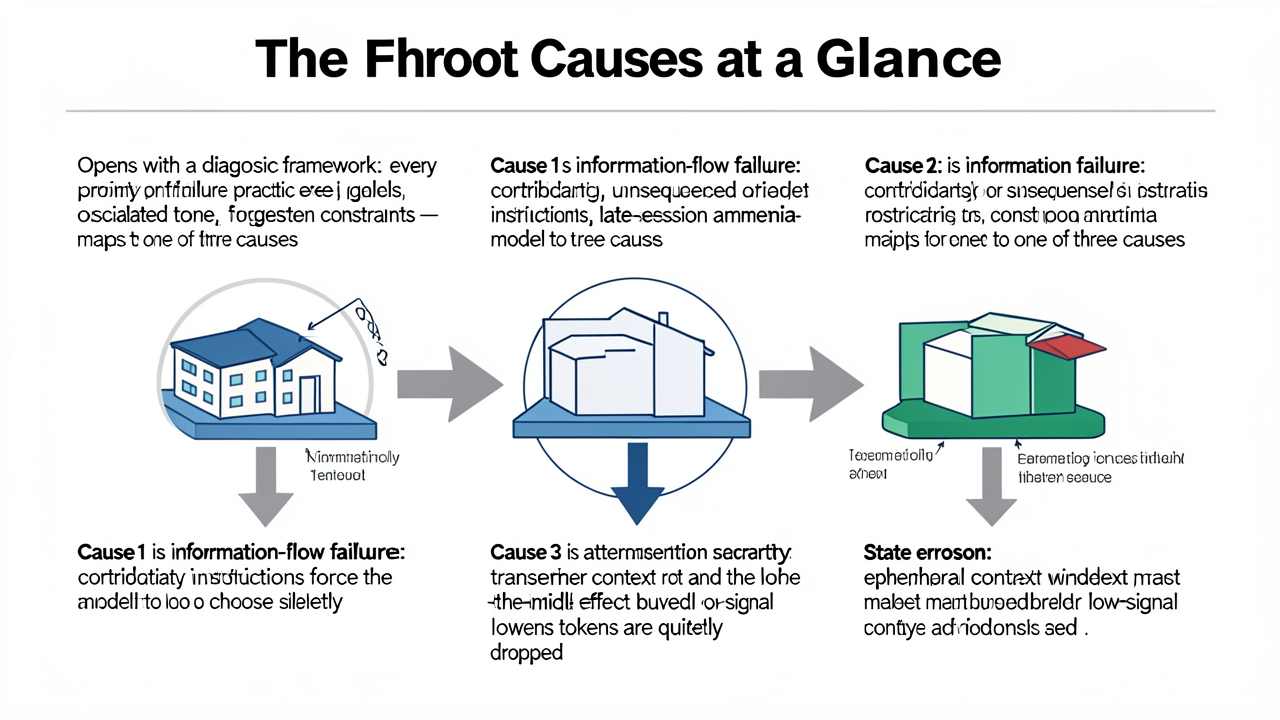
Production prompt failures are not random. Whether a rule is silently dropped, a tone oscillates between responses, a constraint is forgotten halfway through, or the model seems to "amnesiac" by turn fifty, the cause is almost always one of three recurring structural problems. Treating symptoms with surface-level tweaks ("rewrite the instruction," "add an example," "bump the temperature") tends to miss the underlying mechanism. The faster you can map a symptom to its root cause, the faster you can pick the right fix.
The three causes are:
| Symptom | Likely cause |
|---|---|
| Model picks one rule and ignores a conflicting one | Information-flow failure |
| Critical instruction buried in a long prompt is skipped | Attention scarcity |
| Output is vague or contradicts an earlier example | Information-flow failure |
| Compliance drops after a long session or many tool calls | State erosion |
| Constraints work on turn 1 but fail by turn 50 | State erosion |
| Model attends to start/end but ignores middle | Attention scarcity |
Each subsequent section takes one cause, pairs it with a concrete diagnosis checklist, and ends with a fix drawn from context-engineering practice.
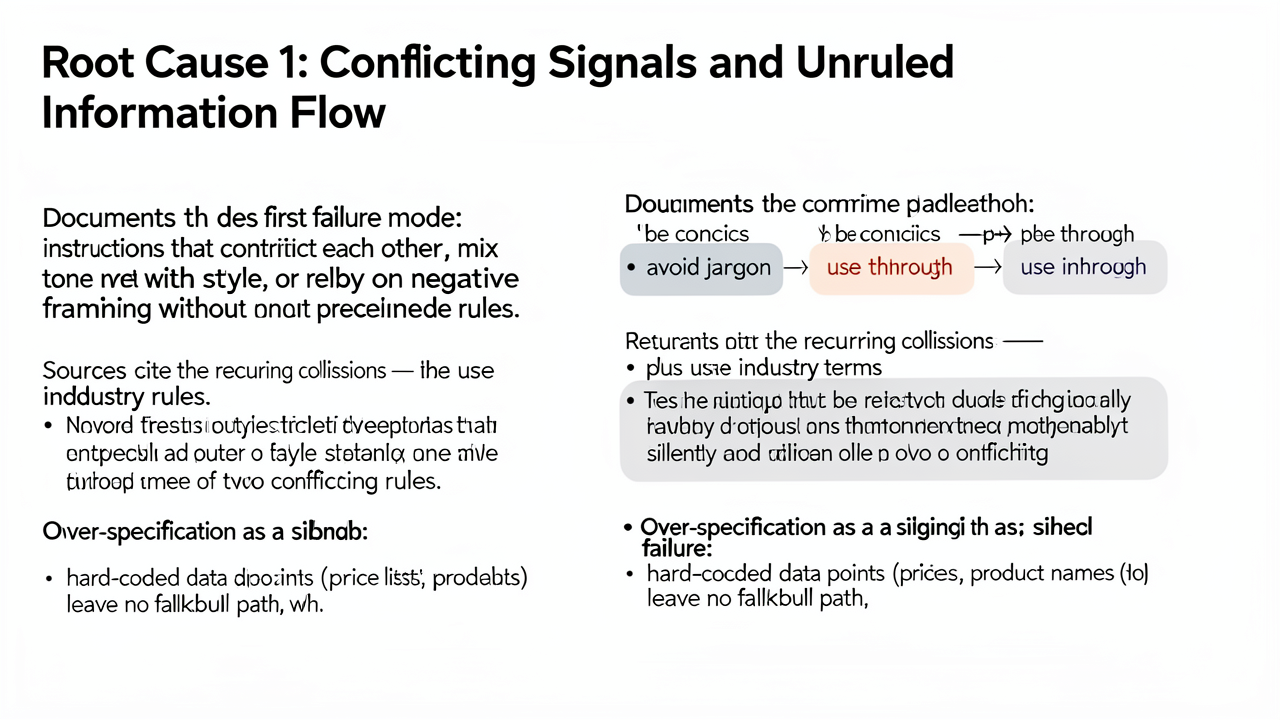
The most reproducible failure pattern is two rules that ask for opposite things in the same context. The literature on prompting mistakes catalogues recurring collisions: "be concise" paired with "be thorough", "avoid jargon" paired with "use industry terms", "short answer" paired with a long list of items to cover (ai-tldr.dev). When a model hits a pair like this, the documented symptom is that it either mixes styles unpredictably — formal in one paragraph, casual in the next — or silently drops one rule and follows the other. Because the prompt never said which rule wins, the model picks, and the choice changes across runs and across temperature settings.
A second collision type is mixing concerns that should be separated. Asking a model to be "super friendly, ultra-formal, and highly technical" smears tone, register, and vocabulary into a single instruction the model has to resolve on its own (dev.to/simplr_sh). Separating "Always be friendly and respectful" (tone) from "Provide detailed technical explanations when requested" (style) gives the model two independently weighable constraints.
Negative framing makes the collision worse. Telling a model "don't use bullet points" activates the concept of bullet points first — the so-called pink elephant problem — and then asks the model to suppress it (thomas-wiegold.com). The reliable fix is to reframe every negative as a positive target: "use continuous paragraphs" rather than "do not use bullet points".
Two more failure modes sit next to direct contradiction. Over-specification hard-codes data — exact price lists, product names, regional defaults — and leaves no fallback when the data goes stale or the input falls outside it (blog.stackademic.com). Vague descriptors do the opposite: "professional and friendly" describes every corporate assistant and steers nothing (aicodex.to). Both fail for the same reason: the model has no concrete target to hit. Quantifiable constraints — word counts, sentence counts, audience reading level, named sections — replace adjectives with measurable shape.
Without an explicit precedence rule, the model is forced to arbitrate between conflicting signals on its own, and arbitration is the least stable part of inference. The recommended pattern is a priority stack inside the system prompt: safety and legal rules at priority 1 (never violated), accuracy at priority 2, tone and formatting at priority 3, personality at priority 4 (pecollective.com). Conditional meta-instructions — "Use imperial units only if location=US is confirmed, otherwise default to metric" — close the remaining gaps so the model does not have to guess which rule wins.
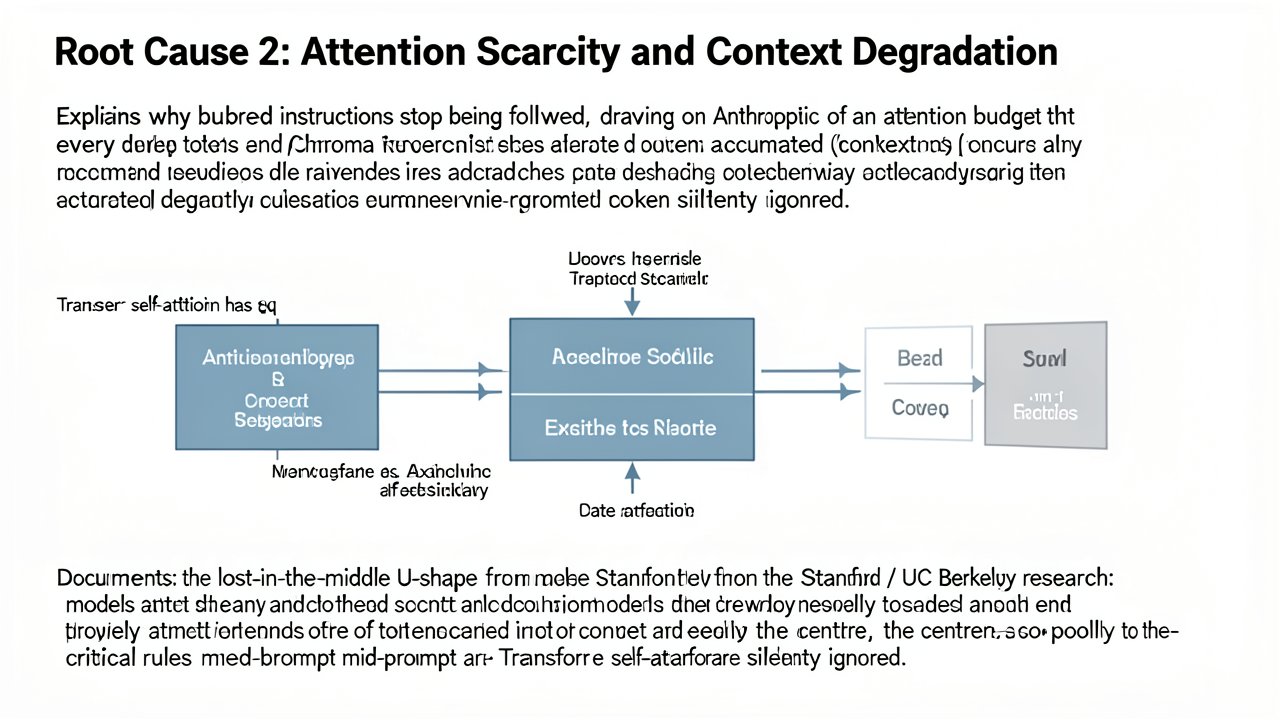
Every prompt lives under an attention budget — a fixed supply of focus that the model draws on as it parses input. Each token added to the prompt consumes part of that budget. This is not a metaphor: it is a direct consequence of transformer architecture, where every token must attend to every other token, producing n² pairwise relationships for n tokens. As context grows, those relationships get stretched thin, and the model loses precision on retrieval and long-range reasoning.
Chroma's "context rot" research (July 2025) tested 18 frontier models including GPT-4.1, Claude 4, and Gemini 2.5, and found that retrieval performance degrades as context length increases, even on straightforward tasks. A separate January 2026 systematic analysis identified a "context cliff" around 2,500 tokens where response quality drops sharply. The implication: stuffing more material into context dilutes attention rather than sharpening it. Dumping large, unfiltered context at an agent both increases token cost and lowers accuracy.
The Stanford / UC Berkeley research on long-context behaviour (Liu et al., 2023) demonstrated a U-shaped attention pattern: models attend strongly to the start and end of a context window, and poorly to the centre. A critical rule buried mid-prompt is therefore silently ignored, even though it is technically "in context." A 1M-token window does not behave like 1M tokens of perfect memory; an agent can overlook a critical detail at position 500K simply because it sits in the dead zone.
Self-attention has quadratic complexity in sequence length, so doubling the input roughly quadruples the pairwise attention work. This makes million-token windows expensive on every axis — compute, memory, latency, and accuracy. The architectural cost compounds with the behavioural one. Larger windows give the model more room to lose the thread, not more ability to hold it.
A2,000-token system prompt often performs worse than a focused 400-token one because attention is finite real estate. The implication for builders:
<system-reminder> injections to refresh critical rules via recency bias, rather than pre-loading every rule.Treat context as a budget with diminishing marginal returns. Spend tokens only on what changes the output — curation over accumulation is the whole discipline in one sentence.
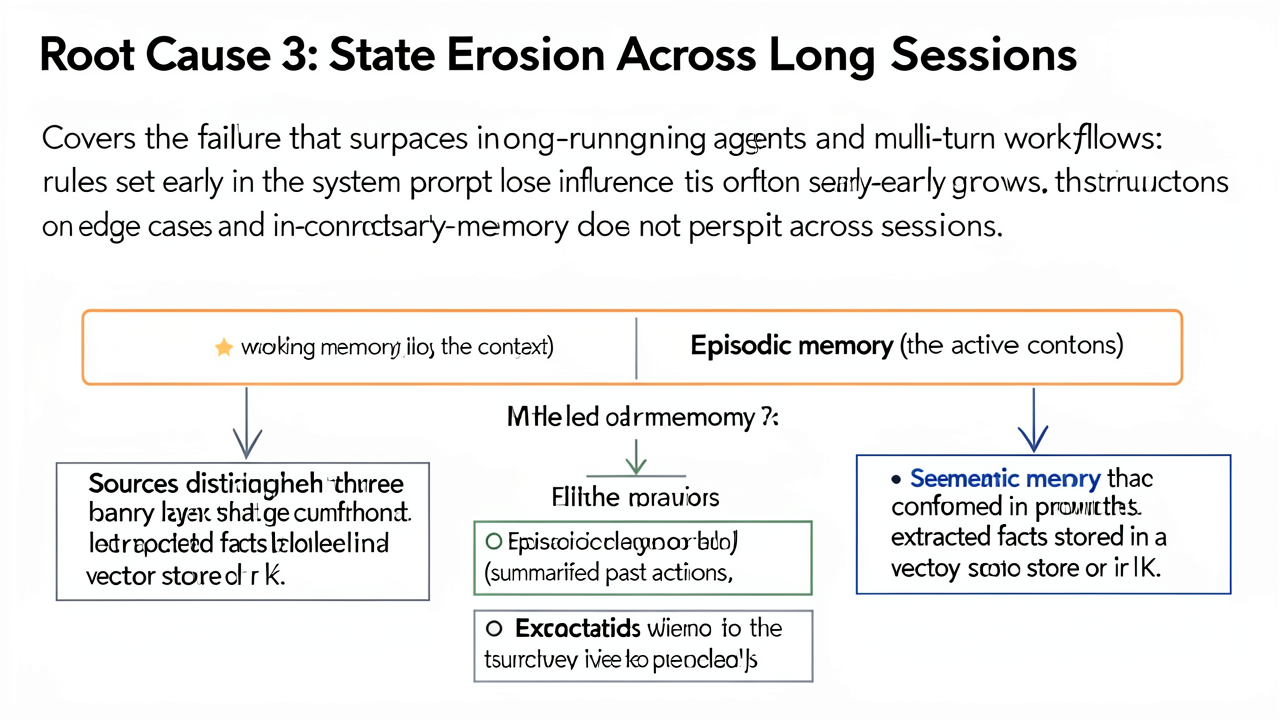
Long-running agents and multi-turn workflows expose a third failure pattern that is distinct from prompt placement or instruction conflicts. As the conversation grows, rules set early in the system prompt lose influence, the model starts ignoring early-system instructions on edge cases, and any knowledge that was not explicitly re-stated drifts out of attention. LLMs are stateless between API calls, and even within a single call, attention over a crowded context window is not uniform: relevant content in the middle is more likely to be skipped than content near the beginning or the end, a phenomenon documented as the "lost in the middle" effect. One empirical study of long agent sessions found instruction fade-out becomes reproducible once a session exceeds roughly 15 tool calls: a coding agent told to always run tests after editing code does so for the first few turns, then quietly stops, even though the rule is still in the system prompt.
Two compounding failure modes drive this:
Production prompts routinely blur three distinct memory layers, and that confusion is what causes state to erode:
Conflating these layers — for example, by stuffing episodic logs or semantic facts into the system prompt — guarantees that working memory fills up faster and that early rules get crowded out.
The fix is to separate concerns rather than to cram more into the prompt:
For long sessions specifically, two operational patterns help. First, inject short, single-purpose reminders at the decision point where a rule would otherwise be forgotten, rather than relying on the original system-prompt placement after hundreds of turns. Second, bound session length and create fresh threads for new chunks of work instead of keeping a single session open all day, so working memory does not silently overflow and evict the rules you actually need.
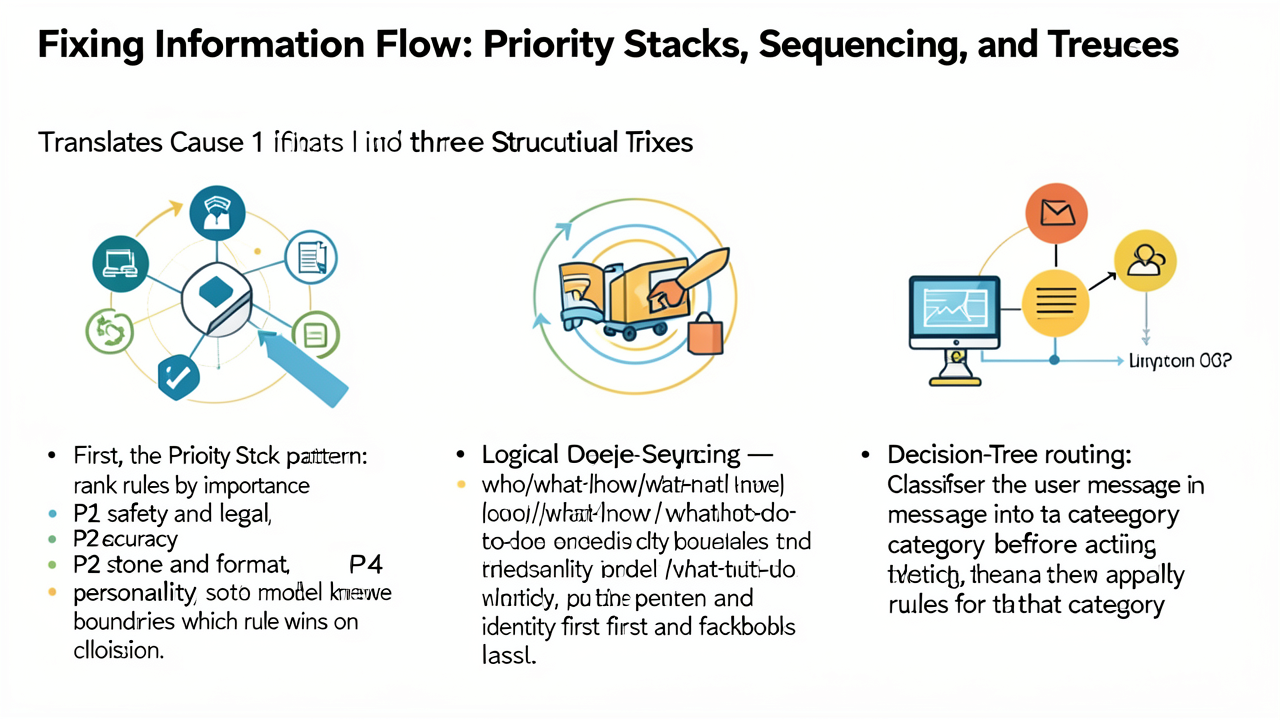
When several rules can collide, the model cannot infer which one matters most unless you tell it. The Priority Stack pattern makes precedence explicit by ranking rule categories from non-negotiable to nice-to-have:
With this stack, a conflict like "be funny" versus "be accurate" resolves itself: the model knows accuracy wins (pecollective.com). Vendor systems often formalize a similar hierarchy — OpenAI's Codex treats the server-controlled system message as the top of its priority stack, followed by tool definitions, developer instructions, user instructions, and finally conversation history (agent-cookbook.com).
Order within the prompt shapes how rules are read. LLMs exhibit a U-shaped attention curve: they attend strongly to the start and end of context and zone out in the middle (medium.com). Production-grade sequences follow four slots — who you are, what you do, how you respond, what not to do — placing identity and boundaries first and fallbacks last (blog.stackademic.com). If two instructions genuinely conflict, declare the tie-breaker inline: "If tone and safety conflict, prioritize safety."
For prompts that handle heterogeneous user intents, classify first, then act. Ask the model to assign the message to a fixed list of categories, then apply the rules for that category (pecollective.com). For example: "First, classify the user's message into one of [billing, technical, feature-request, off-topic], then follow the instructions for that category." Routing before responding produces more consistent behavior than asking the model to improvise across many branches at once.
"Don't mention competitors" instructs the model to suppress a concept, which makes the concept more salient — a tendency sometimes called the pink elephant problem (thomas-wiegold.com; ai-tldr.dev). Positive framing outperforms negation because it gives the model a target behavior rather than a thing to avoid. Rephrase "don't mention competitors" as "when asked about competitors, redirect to our comparison page." The same rewording applies elsewhere: "don't use bullet points" → "write in continuous paragraphs," "don't be too formal" → "use a friendly, conversational tone." Positive instructions describe a target state; negative instructions describe everything except one (help.openai.com).
The cure for attention scarcity is not more tokens; it is stricter editing. Treat the context window as a finite budget with four claimants — instructions, retrieved documents, tool outputs, and conversation history — and ruthlessly drop or summarize anything that does not change the next token. The guiding rule, repeated across the context-engineering literature, is to spend context only on what changes the answer (Medium – Prompt Engineering Basics 2026).
Liu et al.'s "lost in the middle" research showed that transformer accuracy is highest when relevant information sits at the beginning or end of the context, with drops of more than 30 percent for content buried in the middle (NeuralTrust – Context Window Optimization, Thomas Wiegold – Prompt Engineering Best Practices 2026). Three concrete moves exploit this:
For RAG pipelines, this means ordering retrieved passages first, then history; for agent loops, current task instructions first and the most recent tool output last (NeuralTrust – Context Window Optimization).
Few-shot examples are powerful but expensive — they consume tokens on every call and they dilute attention away from rules (Medium – Prompt Engineering Basics 2026). A cleaner division of labor:
<example> tags so the model can distinguish them from instructions (Claude – Prompting Best Practices).Min et al. (2022) found that the label space and input distribution matter more than whether example labels are perfectly correct — so invest in diversity, not polish (Thomas Wiegold – Prompt Engineering Best Practices 2026).
Run a regular budget audit. For each of the four claimants, ask: does this change the next token?
The Anthropic framing is sharp: context engineering aims to find the smallest set of high-signal tokens that maximizes the likelihood of a desired outcome (Anthropic – Effective Context Engineering for AI Agents). Give the model the right folder, not the whole filing cabinet. A 1M-token window is not a license to add more — it is a license to waste more, and wasted tokens cost latency, money, and accuracy on every turn.
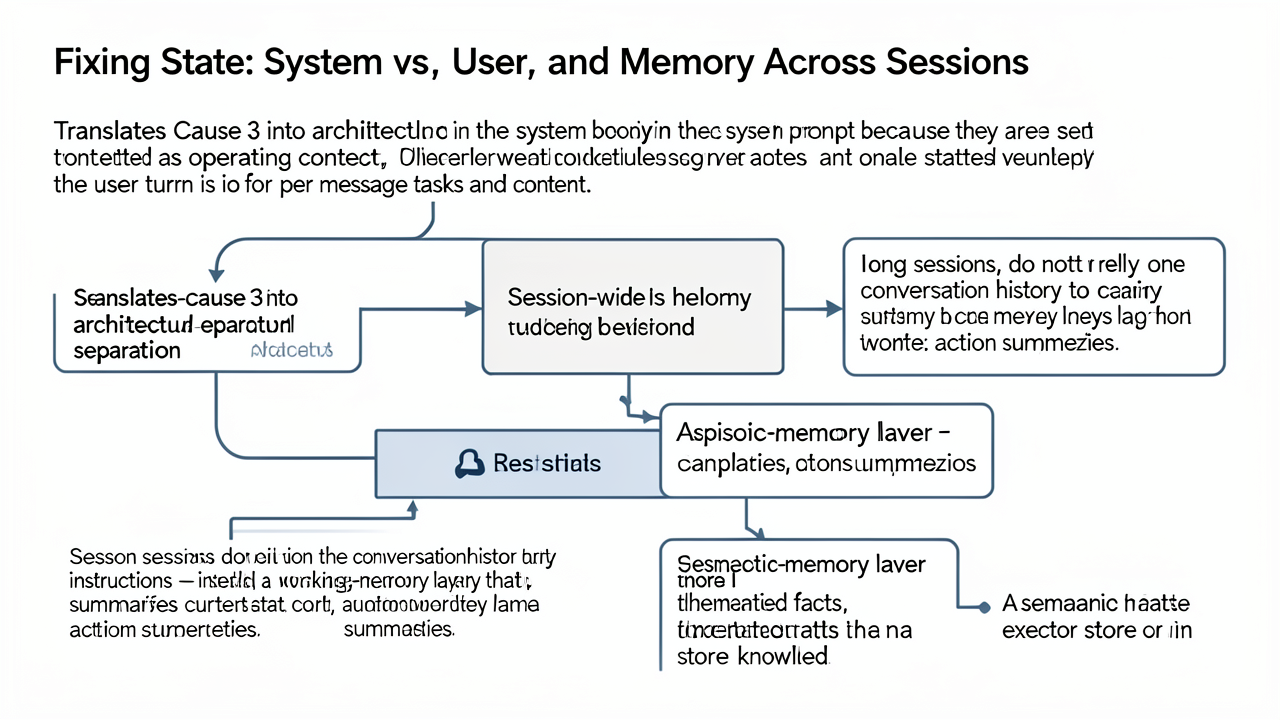
The third cause of prompt failures is a state-management problem. Session-wide rules, persona, output contracts, and tool inventory belong in the system prompt because that message is loaded once and treated as operating context on every turn. The user turn is the wrong place for those rules because it is dynamic, ephemeral, and weighted lower by the model. Practitioner write-ups repeatedly describe the system prompt as a "job description" or "BIOS configuration" that persists across turns, while the user prompt is the "current order" being processed through that lens (coddykit.com, 2slides.com).
For long sessions, do not rely on the conversation history to carry your instructions. History drifts, fills with noise, and gets truncated. Build a working-memory layer instead, following the three-store decomposition used in agent architectures (varunpratap.com):
On each new turn, retrieve only the relevant slice from semantic and episodic memory and inject it into the context. This is cheaper than replaying history and far more reliable.
For tasks that span hours or many sessions, Anthropic's prompting guidance recommends explicit state handoff: when a context window approaches its limit, have the model save a compact state summary (open todos, decisions made, files touched, next action) to an external file such as NOTES.md, then resume the next session by re-reading that file in a fresh context window. Anthropic's Effective harnesses for long-running agents codifies this with initializer agents, persistent feature lists, and init.sh bootstrapping (github.com/walkinglabs/awesome-harness-engineering, anthropic.com). The principle: agent state lives in files, not in the context window.
Finally, a warning: the system prompt is not a security boundary. Untrusted user input can still override system instructions through prompt injection, so defenses (input sanitisation, output filtering, tool allowlists, privilege separation) must be implemented as a separate concern and not assumed to be solved by prompt wording alone (coddykit.com).
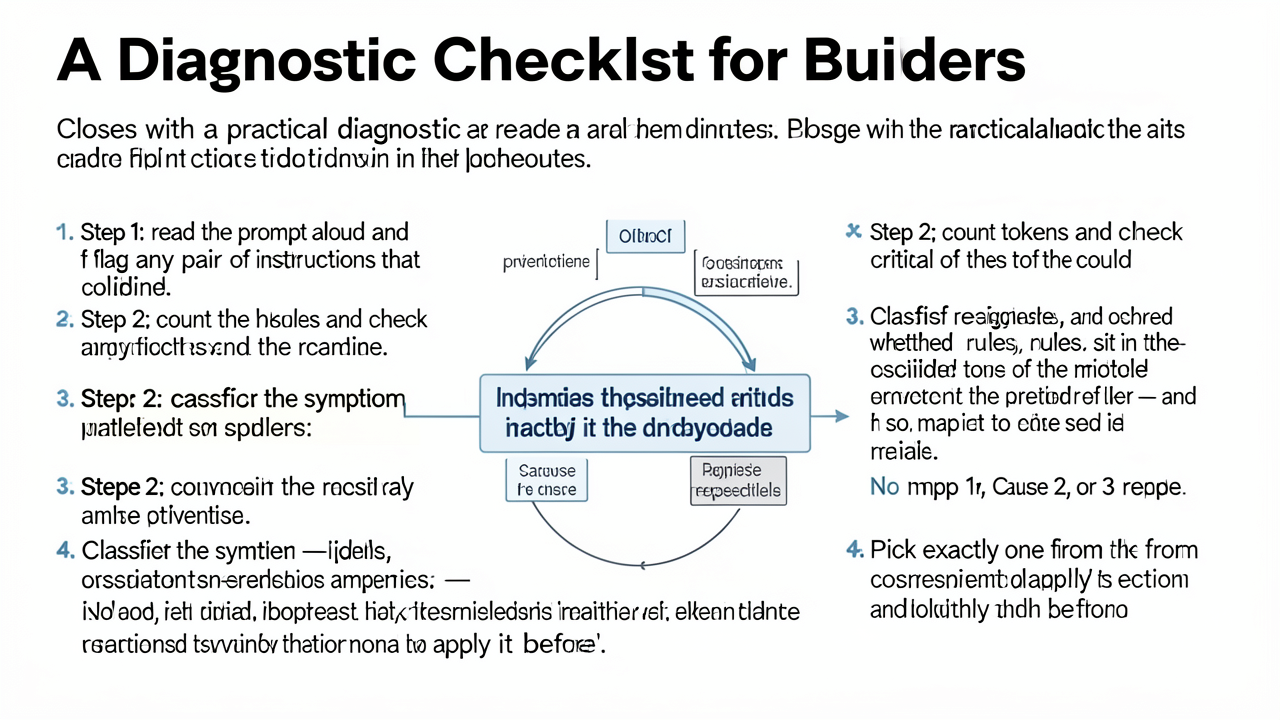
When a system prompt stops working, the fastest path back to reliability is a short, structured triage rather than another rewrite. The following five-step checklist runs in roughly fifteen minutes and forces the diagnosis before the fix.
Step 1 — Read the prompt aloud and flag colliding instructions. Spoken cadence exposes contradictions that the eye skims over. Mark any pair where one rule constrains what another rule requires (for example, "be concise" alongside "always provide detailed explanations," or "never apologize" paired with "empathize first"). Each collision is a precedence problem: the model will pick one rule and drop the other, and there is no guarantee it picks the one you care about.
Step 2 — Count tokens and check instruction placement. Count the whole prompt, then locate where the load-bearing rules sit. Prompts that exceed roughly 2,000 tokens begin to lose focus, and rules buried in long blocks fade regardless of total length because of attention dilution across the middle of the context. If a critical rule is not in the opening section or near the closing summary, move it. Token budgets only help if the attention budget is also respected.
Step 3 — Classify the symptom and map it to a cause. Three failure signatures cover most production reports:
Step 4 — Pick exactly one fix and apply it. Resist the urge to change three things at once. Choose the single highest-leverage fix from the corresponding section, edit the prompt, and save it as a new version.
Step 5 — Re-run the minimum-viable evaluation suite. Use the same inputs you used before, scored against the same rubric. A useful baseline is 20–50 real cases drawn from production logs, with two or three quality dimensions defined up front and a clear pass threshold. Run the new version against that set and compare scores to the previous baseline. If the change does not move the metric, revert and try the next fix from the mapped cause.
The three fixes converge on a single principle: a working prompt is one where precedence rules, attention budget, and memory architecture are each deliberately sized, not accumulated by accident.