

GLM-5.3-Flash ships with open MIT-licensed weights, but its 320B-parameter checkpoint sets a hardware floor that rules out most single-machine deployments. Published deployment analyses place the native FP8 weight footprint at roughly 306 GiB before any KV cache, runtime state, or multimodal overhead is counted. The practical serving floor is an 8-GPU Hopper-class node, while quantized and CPU-GPU hybrid paths lower the entry cost at measurable quality and speed trade-offs. For solo engineers and small teams, the decision comes down to four numbers: the resident weight budget, KV-cache capacity at the intended context length, system RAM available for hybrid offload, and the role local NAS hardware can play. This guide consolidates the published hardware, memory, and topology figures into a deployment-ready planning checklist, noting where sources disagree and which claims are tied to specific engine versions.
Before choosing any hardware, the first calculation is the weight budget itself. GLM-5.3-Flash's 320B-parameter checkpoint sets the floor for everything that follows, and a few clean arithmetic anchors make the rest of the planning tractable.
The widely cited first-order estimates for the raw weight footprint are:
The native FP8 checkpoint lands close to that one-byte-per-parameter figure: published analyses report approximately 306 GiB of weights and an on-disk size in the 328–331 GB range, depending on the source. The BF16 number, by contrast, ranges from about 640 GB to 772 GiB across sources, depending on whether runtime overhead is folded into the figure.
These numbers are weight-only arithmetic, not measured server requirements. A working deployment must additionally account for:
One published serving analysis recommends roughly 386 GiB of VRAM for the default FP8 deployment, which is about 25–30% above the raw weight size. That ratio is a useful planning default: for short-context serving, budget weights plus roughly 25% headroom; for long-context windows, push the headroom higher to absorb KV-cache growth.
A second caveat is that on-disk checkpoint sizes do not match perfectly across sources. The official FP8 checkpoint is cited at 328.3 GB by some analyses and around 331 GB by others, a small but real discrepancy that can matter when sizing a filesystem or a NAS target. The same applies to BF16, where the gap between 640 GB and 772 GiB reflects different assumptions about what is included in "checkpoint size."
The practical recommendation: treat the weight budget as a baseline, add roughly 25% for short-context serving, and increase that margin as you approach the model's longer context windows. Quantization lowers the floor, but it does not remove it — every level of compression trades quality and speed for memory, and those trade-offs are easier to reason about once the underlying weight arithmetic is fixed.
The published floor for the official FP8 checkpoint is an 8-GPU Hopper-class node. The two configurations that consistently appear in serving recipes are:
The full 1,048,576-token window is only documented for the 8× B200 configuration in the official vLLM recipe (aireiter).
Several published analyses claim the FP8 checkpoint already runs on smaller topologies: a vendor guide references a 4× H200-class node, vLLM publishes a TP4 example on a single GB200 tray, and SGLang lists TP4/EP4 on 4× GB300 for verified recipes. The official Z.ai / NVIDIA documentation, by contrast, names 8× H200 (or H20) as the standard FP8 topology. The sub-8-GPU paths are tied to specific engine versions, NVFP4 community re-quantizations, or Blackwell-only hardware — they should not be read as general capability statements. Treat them as recipe-bound, not as floors.
The largest single cards in common GPU cloud lineups carry 96–192 GB. Even the 192 GB B200 holds under a third of the FP8 weights, which is why the model is, in practice, a datacenter self-hosting proposition rather than a workstation install.
The Unsloth dynamic GGUF ladder provides the most accessible path to GLM-5.3-Flash below the 8-GPU Hopper floor. Memory and accuracy scale together, but the curve is steep at the bottom:
Above the ladder sits the official FP8 checkpoint at roughly 350 GB and BF16 at roughly 650 GB, both well above the sub-datacenter budget (Unsloth, Codersera).
Sources disagree on the absolute minimum for the 1-bit build: one guide lists UD-IQ1_S at ~93 GB, while another reports ~217 GB on disk and ~230 GB of combined memory. The wider range is likely a mismatch between raw weight size and resident runtime footprint with KV cache, so plan for the higher figure when sizing hardware.
Below 64 GB of combined memory, no published quant of GLM-5.3-Flash can run, regardless of compression. Standard MacBooks sit in that range and are not viable targets. On supported Apple Silicon, macOS caps GPU-addressable memory at roughly 75% of unified memory by default, so a 192 GB Mac Studio effectively offers ~144 GB to the model rather than the full pool. The full 320B checkpoint never fits, even on the largest Apple-shipping unified-memory configurations.
For shops that already own a single RTX 40- or 50-series card (SM89/SM120), the KTransformers route moves most experts into system RAM and runs an AVX-512 FP8 CPU kernel for the offloaded layers. Published guides call for roughly 350 GB of available system memory; some sources cite 384 GB, and the range is source-dependent rather than a contradiction. Either way, the host must hold the bulk of the model in DDR5, and weight movement plus CPU execution make this path far slower than GPU-resident serving. Treat throughput in tokens per second as a tenth or less of comparable VRAM-resident deployments, and budget PCIe bandwidth and memory channels accordingly (ZimaSpace, BuildFastWithAI).
GLM-5.3-Flash advertises a 1,048,576-token context window, but the headline number is a maximum capability rather than a default operating point. Sizing the KV cache for that ceiling requires understanding what is and is not stored per token.
The 45-layer language model interleaves two attention types: 11 layers use NoPE sparse MLA with a conventional paged KV cache, while the other 34 layers use KDA (Kimi Delta Attention) linear attention with a fixed-size state. Because linear attention keeps its state flat regardless of sequence length, only 11 layers contribute to per-token cache growth. The architectural payoff is concrete: roughly 3.0× less attention compute and a 4.44× smaller KV cache than the dense GLM-5.3 at million-token evaluation contexts (eigent.ai, kie.ai). Compared with a hypothetical 45-layer dense transformer, the per-token savings are about 4× (atomic.chat). At very long contexts, Z.ai's IndexPool component compresses groups of indexer key vectors to keep latency and memory in check (marktechpost.com).
A representative published reference point: vLLM measures a ~14.92M-token KV pool at TP=4 with FP8 weights and an FP8 KV cache, which corresponds to roughly 114× concurrency headroom relative to a 131,072-token batch at the same pool bytes (codersera.com). FP8 KV cache is what makes 1M context viable on 8× H200 rather than forcing a larger node (spheron.network).
Z.ai's own published evaluations run at ~300K tokens with context management (yottalabs.ai), and the validated KTransformers example uses a 501,025-token configuration rather than the headline limit (shop.zimaspace.com). Three additional load factors compound KV and state pressure:
--max-mamba-cache-size or --mamba-full-memory-ratio and then re-tuning --max-running-requests to the workload (docs.sglang.io).Per-token cache figures above are config-derived estimates; the Atomic Chat team explicitly notes that measured harness numbers will be published after running GLM-5.3-Flash on their own rig, not estimated from configuration (atomic.chat). Engine versions also matter: SGLang defaults to BF16 KV with TileLang DSA on H100/H200, while FP8 KV with TRT-LLM DSA is Blackwell-only and yields 1.8× KV token capacity at identical pool bytes on GB300 (docs.sglang.io).
GLM-5.3-Flash had day-one support across several inference engines, with vLLM and SGLang as the two primary self-hosting paths. Each engine treats the checkpoint differently, and the differences drive the topology decision.
vLLM treats the default zai-org/GLM-5.3-Flash-FP8 checkpoint as native FP8 and documents a roughly 306 GiB weight footprint. Current builds support NVIDIA Hopper-class GPUs and newer. A published reference is a tensor-parallel size of 4 on a GB200 tray, framed as a high-performance deployment reference rather than proof that any four GPUs will fit. Setup guides recommend allocating about 90% of GPU memory (--gpu-memory-utilization 0.90) to leave headroom for the KV cache under concurrent agent workloads, and using --kv-cache-dtype fp8 for long-context runs. Other documented vLLM flags include 5-token multi-token prediction (--speculative-config.num_speculative_tokens 5), automatic tool choice, and the GLM-specific reasoning and tool-call parsers.
SGLang is positioned for advanced and distributed serving and is the engine Z.ai's own post-training stack uses. The model maintains a paged KV pool plus a separate KDA state pool. In practice, the KDA state pool can become the concurrency bottleneck before the KV pool fills, so operators should either raise the mamba full-memory ratio or set the mamba cache size to expected concurrency, keep prefix caching enabled, and leave the checkpoint's linear lower-bound setting untouched. SGLang exposes two launch strategies: a Low Latency profile that starts with adaptive MTP 5/1/6 speculative decoding and tensor parallelism for chat and agent traffic, and a High Throughput profile that disables speculative decoding for sustained batches. Speculative decoding is served through --speculative-algorithm EAGLE.
The vLLM Ascend tutorial documents Ascend-based paths whose supported-hardware lists and flags shift between releases:
Across the multi-node Ascend paths, weights are shared from a common cache directory, and msmodelslim is available for on-node quantization. KTransformers remains an option for heterogeneous CPU–GPU expert inference and single-GPU launches, at the cost of CPU offload bandwidth.
Pin engine versions when reproducing any published recipe, since supported-GPU lists, quantization flags, and parallelism defaults shift between releases.
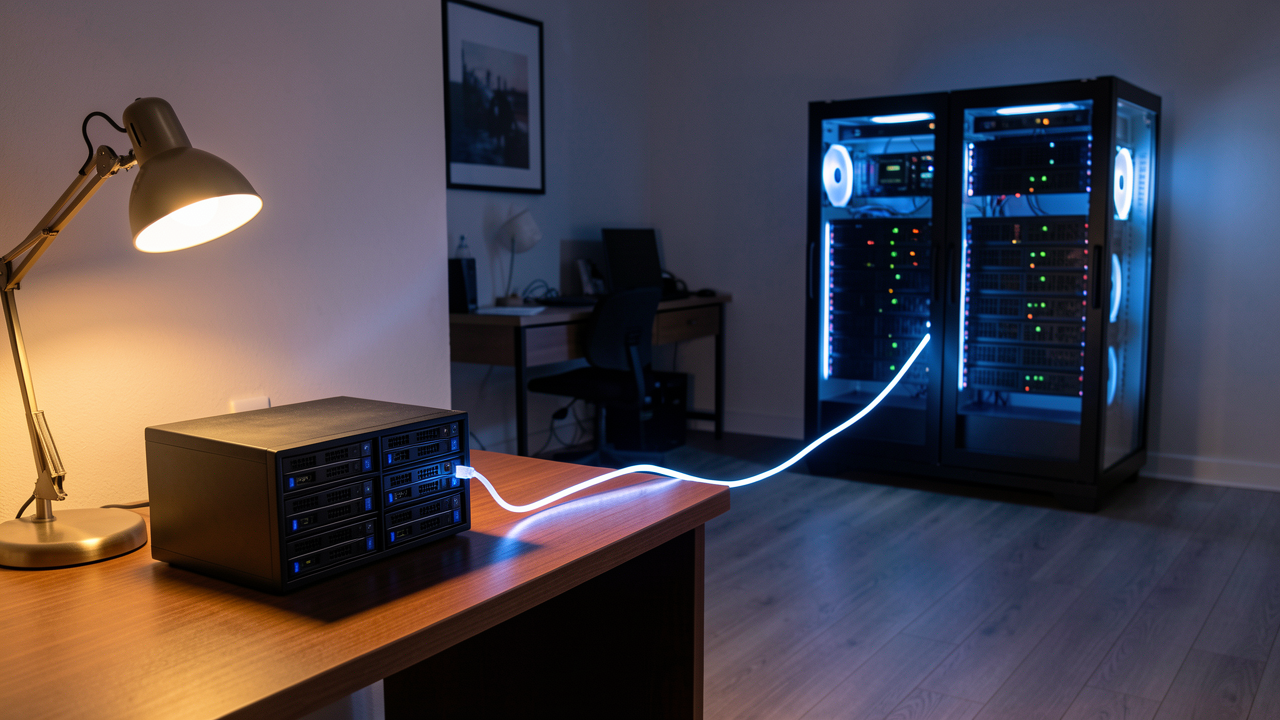
A standard home server or NAS cannot serve as a full GLM-5.3-Flash inference node. The native FP8 checkpoint alone occupies roughly 306 GiB before any KV cache, activations, or runtime buffers are added, and the documented CPU-GPU hybrid path (e.g., the KTransformers configuration) calls for at least ~350 GB of available system memory, a figure that already excludes application services and workload margin. Both numbers are well beyond what most consumer or prosumer NAS enclosures ship with by default.
Even if it cannot run full inference, a home server or NAS-class system can carry the surrounding workload:
This split is often more useful than forcing a frontier-scale checkpoint onto unsuitable hardware, because it keeps sensitive data on-premises while still granting access to higher-quality outputs.
ZimaSpace markets the ZimaCube 2 as a "data and service layer" rather than as an inference server. According to vendor material, the system can centralize model files, private documents, RAG corpora, application data, backups, containers, retrieval services, and request orchestration while keeping those resources under local control. This positioning is from the vendor and has not been independently benchmarked for GLM-5.3-Flash throughput or latency, so it should be treated as architectural guidance rather than validated performance.
A practical pattern is to run smaller models that fit the NAS's CPU, memory, and accelerator configuration locally for immediate or low-latency queries, and route frontier-scale prompts to a GPU node, a rented H200 instance, or a hosted endpoint with a published SLA. Persistent storage must exceed the selected checkpoint to cover downloads, containers, caches, logs, and temporary data. The decision is less about squeezing a 320B checkpoint into insufficient hardware and more about giving each tier of the stack a role it can actually fulfill.
Source: ZimaSpace — GLM-5.3-Flash Local Hardware & RAM Requirements

Before committing capital to an 8-GPU node, most teams benchmark the hosted build first. Z.ai operates an official API, and the model also appears on the OpenRouter catalog with multiple gateways (DeepInfra, FriendliAI, Novita). A useful planning baseline: published third-party measurements place hosted output throughput at roughly 49 tokens/sec with a ~1.52 s time-to-first-token, while OpenRouter's best provider shows 107–126 tok/s P50 and 0.41–0.57 s P50 latency. Treat hosted numbers as context, not as expectations for a self-hosted build; self-hosted results depend on interconnect, batch size, context length, and the serving engine version.
The table below maps the resident weight and system-memory budgets an operator is likely to have on hand to the serving path each budget can support.
| Combined memory available | Practical path |
|---|---|
| Under 64 GB | No viable path for the 320B checkpoint; route to a smaller GLM variant or a non-local model |
| 100–128 GB | 1–3 bit dynamic GGUFs (Unsloth IQ1/IQ2/IQ3); expect measurable quality loss and treat as experiments only |
| 128–256 GB workstation or Mac | 4-bit builds (UD-Q4_K_XL, AWQ INT4) on unified memory or a multi-GPU workstation |
| ~350 GB system RAM + RTX 4090/5090 | KTransformers hybrid FP8 offload; inactive experts to CPU, active compute on the consumer GPU |
| 8× H100 (80 GB) node | Native FP8 serving at moderate context; works because two H200s (282 GiB) do not clear the 306 GiB weight floor |
| 8× H200 (141 GB) node | Native FP8 at long context approaching 300K–1M tokens; the recommended tier for production |
The fastest way to avoid a costly mis-purchase is to rent the target node by the hour and replay production traffic at the intended context length and concurrency. Document three numbers per configuration: prefill latency at the longest prompt, decode throughput at the steady-state batch size, and observed KV-cache growth across a 300K-token run. Only after those three numbers reproduce on a rented node should the same SKU be evaluated for purchase.
Self-hosting clears the cost bar in two situations: sustained high-volume serving where the per-token API bill exceeds amortized hardware and electricity, and workloads with strict data-control requirements that rule out third-party gateways. For everything else, hosted pricing tends to undercut self-hosting once idle time, cooling, and engineer-hours are priced in.
Supported hardware lists, quantization options, and KV-cache layouts change between engine releases (vLLM, SGLang, KTransformers, TokenSpeed). Before any procurement decision, re-run the weight-budget math and the KV-cache sizing against the engine version that will ship to production, and confirm the chosen path against the official FP8 checkpoint recipe and the relevant community quant repos.