

Cost is the loudest argument for self-hosting with Coolify, but it is not automatically the right one. This article walks through real numbers — VPS bills, cloud PaaS invoices, and the hidden observability costs that appear after the first deployment. It compares Coolify against four popular managed platforms (Vercel, Render, DigitalOcean App Platform, and Fly.io) on pricing predictability, scaling economics, vendor lock-in, and operational burden. The goal is to help an indie developer or small team decide which approach actually pays off for their workload, including the cases where the cloud still wins. Figures cited are mid-2026 prices drawn from public pricing pages, third-party teardowns, and developer-reported numbers.
The first number to lock in is zero. Coolify, the software itself, is published under the Apache 2.0 license and ships with every capability unlocked — there are no feature gates, no per-seat charges, and no user limits to grow into. The official self-hosted page is explicit that "no features are behind a paywall" and that the source is openly auditable. The GitHub repository confirms the same. What that means on an invoice is simple: the software line is $0.
The remaining bill is the hardware line. In mid-2026 a capable VPS —4 vCPU and 8–16 GB RAM, the kind of box that comfortably runs Coolify plus a handful of production apps, databases, and workers — ranges from roughly $6 to $25 per month depending on provider. A Hetzner CX23, refreshed in the June 2026 price adjustment, is listed at €5.49 per month excluding VAT for 2 shared vCPU, 4 GB RAM, and 20 TB of EU traffic, which is the typical entry point. Stepping up to dedicated hardware via the Hetzner Server Auction lands around €40/month for a generation-old i7 with 32–64 GB DDR4 and unlimited1 Gbit/s traffic. OVH and other European providers sit in a similar band. Real-world two-server deployments — one box for the Coolify management plane, one for apps — land at $10–$25/month according to the Temps.sh2026 review.
That hardware line is a flat rate you can quote a year in advance. Deploying a second, fifth, or twentieth application onto the same VPS does not change the invoice, because Coolify just schedules another container on hardware you already own. By contrast, every line item on a managed PaaS invoice — platform fee, managed database, managed Redis, bandwidth overages, serverless invocations — grows roughly linearly with the number of services you stitch together. For predictive budgeting, a fixed VPS cost is structurally different from usage-based pricing: there is no surprise traffic spike that re-prices the month.
It is worth flagging the Coolify Cloud option, which starts at $5/month for two managed servers plus $3/month per additional server, with a 20% annual discount. The nuance that matters for cost analysis is that Cloud only hosts the dashboard; applications still run on user-supplied servers, so the underlying economics do not change. There is no SaaS line item to grow.
The cost floor, then, is roughly $10–$25/month for a production-ready self-hosting setup, with the upper bound determined by how much hardware you choose to rent rather than by the platform itself.
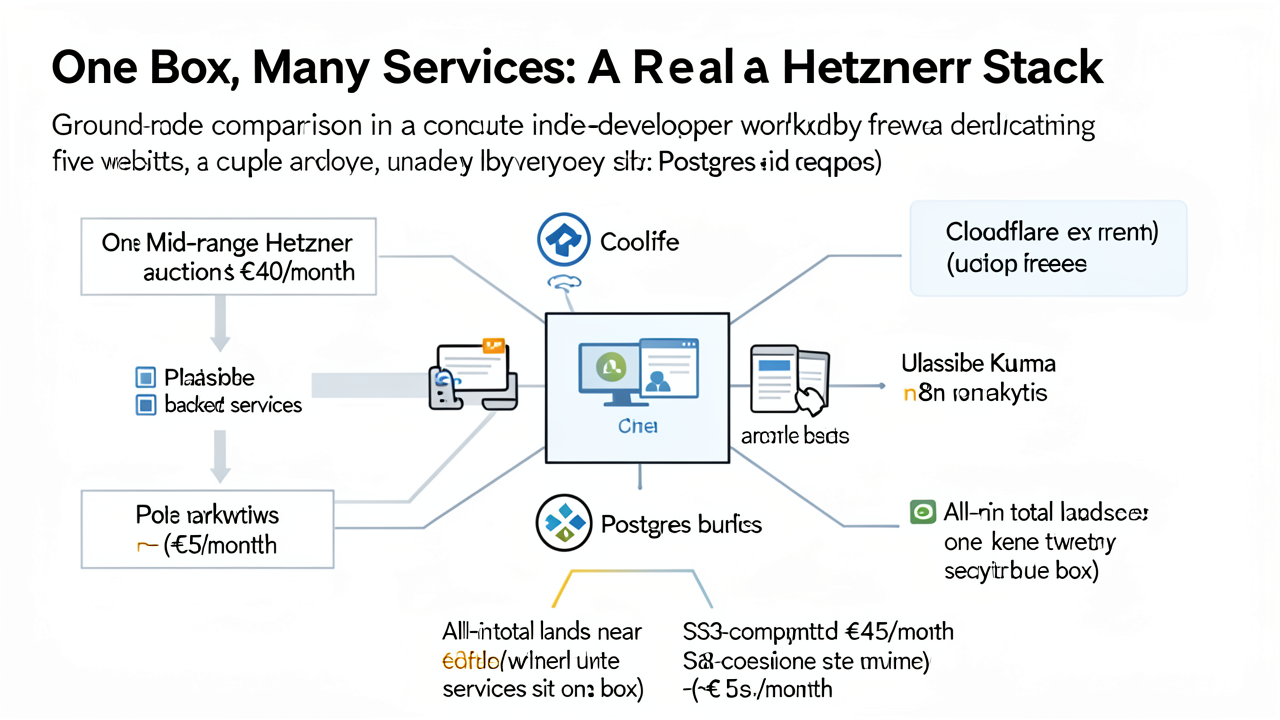
The clearest way to see whether Coolify pays off is to price out one real workload. The darko.io teardown documents exactly this: a single mid-range Hetzner auction server, rented at roughly €40/month, hosting five websites, a couple of backend services, Plausible analytics, Uptime Kuma, n8n workflows, plus a Postgres database and a Redis cache.
Adding the remaining pieces keeps the total essentially flat:
That number barely moves whether the box runs one service or twenty. CPU and RAM are shared across workloads, bandwidth is unmetered within the Hetzner plan, and there are no per-seat or per-function charges. For a workload in the range darko.io describes — five websites, a handful of APIs, plus observability and automation tooling — that single €45 line item is the entire infrastructure bill.
The darko.io napkin math for the equivalent workload on managed platforms lands at $80–150/month once per-service fees, per-seat charges, and bandwidth overages are stacked:
That math tracks with wider benchmarks. The wz-it cost analysis pegs a similar mid-market workload at €400–700/month on Vercel Pro and €350–650/month on Heroku, while a MassiveGRID teardown reports roughly $601/month on Vercel against ~$90/month on Coolify + Hetzner — an ~85% saving before counting operator time.
The savings are not unconditional. The introserv.com observation that returns begin at two or more projects is worth taking seriously: a single landing page rarely beats a free PaaS tier, and a one-service hobby box does not amortize the operator effort. The €45/month figure assumes the developer is comfortable patching the OS, renewing containers, debugging reverse-proxy issues, and accepting the absence of an SLA. Below that threshold — or wherever uptime guarantees, SOC 2, or 24/7 on-call coverage matter — the managed invoice is the cheaper one.
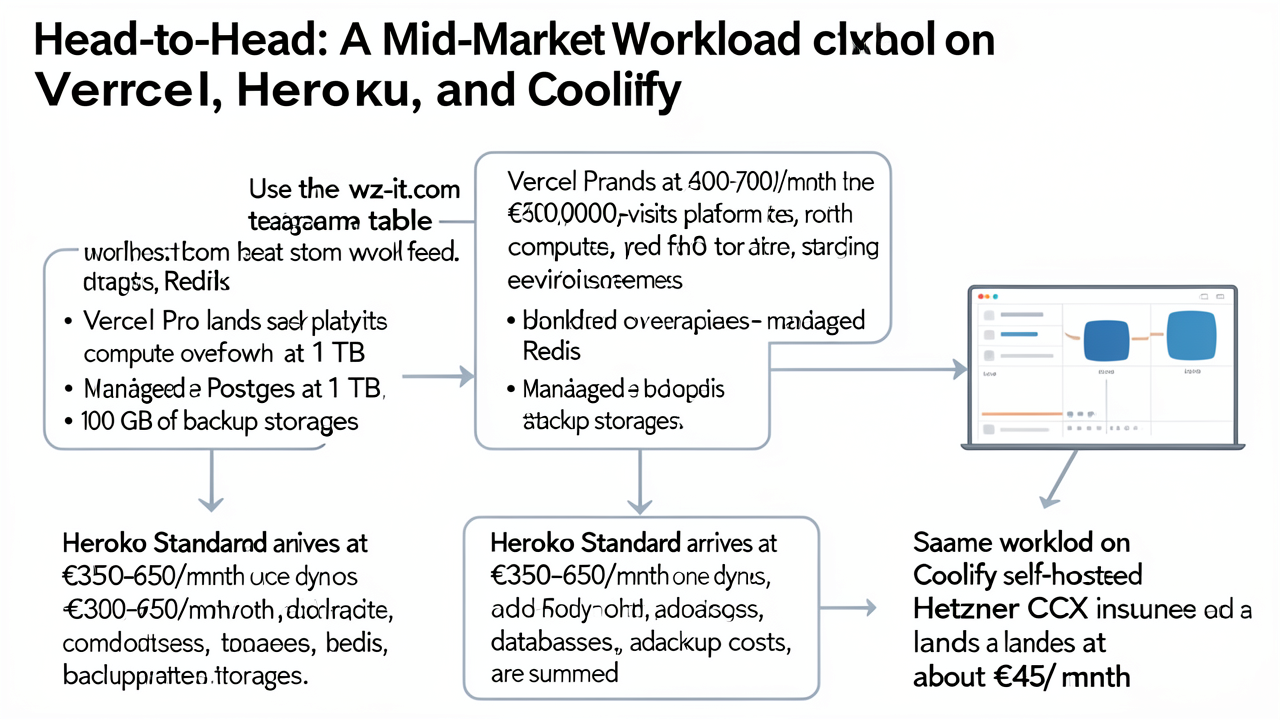
To make the comparison concrete, the wz-it.com teardown models a mid-market workload of roughly 500,000 visits per month, backed by PostgreSQL, Redis, and three staging environments. Each row in the table below represents one recurring line item on the monthly bill, expressed in euros at mid-2026 prices:
| Cost item | Vercel Pro | Heroku Standard | Coolify self-hosted (Hetzner) |
|---|---|---|---|
| Platform / license | ~20 €/user | ~50 €/dyno + add-ons | 0 € (open source) |
| Compute (4 vCPU, 16 GB RAM) | limited included | ~230 € (Performance-M) | ~30 € (CCX range) |
| Bandwidth (1 TB) | 50–150 € overage | 30–50 € add-on | included |
| Function invocations | 40–200 € variable | N/A | N/A |
| Managed PostgreSQL | 20–100 € | 50–200 € | 0 € (self-deployed) |
| Managed Redis | 30–60 € | 15–100 € | 0 € (self-deployed) |
| SSL certificates | included | included | 0 € (Let's Encrypt) |
| Preview deployments | included | 5–10 € per branch | 0 € (unlimited) |
| Backup storage (100 GB) | extra | ~25 € | ~5 € (Storage Box) |
| Total / month | ~400–700 € | ~350–650 € | ~45 € |
Several details explain why the managed platforms cluster in the same band even though their pricing models look different. Vercel's Pro seat fee is small per user, but bandwidth overages and function-invocation charges scale with traffic in ways that are hard to forecast. Heroku looks cheaper on a single Standard-1X dyno, yet a Performance-M dyno, plus Postgres and Redis add-ons, plus per-branch preview apps, push the stack toward the upper end of the range (wz-it.com). Coolify's €45/month figure assumes a Hetzner CCX instance with 4 vCPU and 16 GB of RAM, where bandwidth, TLS, and preview environments are all inclusive or free.
A vendor-independent comparison cited in the same source, originally published by MassiveGRID and reused by lowcloud.io, reaches a similar conclusion in US dollars: about $601/month on Vercel versus $90/month on Coolify for comparable workloads, an ~85% delta. The two analyses are not identical — they use different workload assumptions and different exchange-rate snapshots — but they land on roughly the same ratio, which is a useful sanity check for anyone sceptical of vendor-published numbers.
All figures here are mid-2026 prices drawn from public pricing pages, third-party teardowns, and developer-reported invoices. Cloud vendors revise pricing at least annually, and overage rules in particular tend to change without much fanfare. Before making a hosting decision, re-verify each line against the current pricing page, and price in the operational hours that self-hosting shifts from a credit card to your own team's calendar.
The headline rate on a managed PaaS pricing page is rarely the figure an indie developer actually pays in a bad month. What matters more is the shape of the bill when traffic is uneven.
Managed platforms bill on metered meters that scale with consumption. Vercel charges roughly $0.15/GB for Fast Data Transfer above included tiers and about $2 per million Edge Requests on top of the $20/seat/month Pro plan, and bandwidth costs are reported to spike steeply above the 1 TB monthly cap, especially for image-heavy sites (mgsoftware.nl). Railway's $5 Hobby and $20 Pro plans include matching usage credits, but database-heavy workloads can exceed them and require monitoring against the dashboard to keep the bill from running away (dev.to). Heroku stacks the charges differently but the effect is similar: around €23 per dyno per month, €19 per Pro seat, plus bandwidth and add-on line items that compound when traffic climbs (cloudmagazin.com). Vercel's free Hobby tier is even stricter: hitting a limit takes the site offline until the next billing cycle rather than charging an overage, so there is no pay-as-you-go safety net at the bottom of the ladder (dev.to).
Coolify on a fixed-price VPS removes this failure mode. The software itself is free under Apache 2.0, a capable Hetzner-class VPS runs about $10–25/month for two servers, and bandwidth on European providers is reported as nearly negligible (temps.sh; cloudmagazin.com). The most an indie developer pays in a bad month is the VPS invoice plus S3-style backup storage, both quoted in advance. Independent analysis on introserv.com places the break-even thresholds fairly precisely: above roughly €50–100/month in cloud spend, self-hosting becomes worth evaluating, and above €300/month the switch is almost always significantly cheaper, with 60–70% savings typical.
That predictability is itself a feature, and it has a price. You trade the option value of usage-based elasticity, the ability to ride a viral launch without provisioning servers, for budget certainty. For a solopreneur on tight margins whose worst-case month must fit in a spreadsheet, that trade is good. For anyone expecting hockey-stick growth next quarter, the same trade looks expensive: a fixed VPS caps the upside just as surely as a metered bill amplifies the downside. The right answer depends on which risk keeps you up at night.
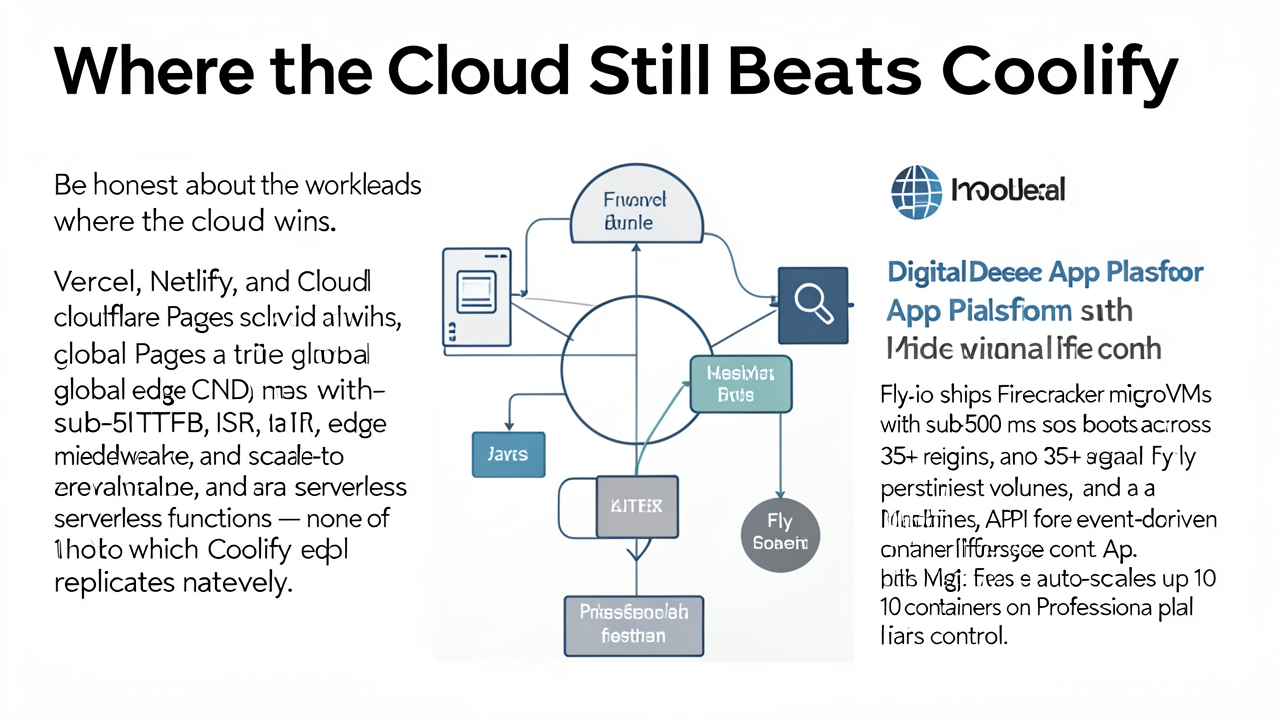
Vercel, Netlify, and Cloudflare Pages serve traffic from a true global edge network with sub-50 ms TTFB in most regions, and they pair that CDN with first-party runtime features Coolify cannot replicate natively: Incremental Static Regeneration (ISR) on Vercel, edge middleware running on V8 isolates (Vercel) or Deno isolates (Netlify), and scale-to-zero functions that bill only for execution time. Coolify, by contrast, runs long-lived Docker containers with a roughly 2 CPU / 2 GB RAM minimum footprint on a single VPS, has no edge runtime, and cannot scale to zero — so low-traffic sites keep paying flat rates regardless of demand. Adding Cloudflare in front of Coolify solves the caching layer but not the missing edge functions or ISR.
Fly.io is the strongest counter-example for indie teams that want Docker without giving up global reach. It runs Docker images on Firecracker microVMs across 35+ regions, with boot times under 500 ms, persistent volumes for stateful services, and a Fly Machines API that exposes event-driven container lifecycle control. Fly Postgres adds managed databases with automatic failover, which is closer to what Heroku or Railway bundle out of the box than anything Coolify ships.
DigitalOcean App Platform handles horizontal scaling declaratively: Professional plans auto-scale up to 10 containers, App Spec YAML treats infrastructure as code, and a 99.95% uptime SLA, built-in monitoring, alerting dashboards, and log aggregation come included. The tradeoff is geography — App Platform deploys only to NYC, SFO, and AMS — but for teams whose users cluster in those regions, the operational savings are large.
Heroku, Railway, Render, and Fly.io ship managed Postgres or MySQL with built-in HA, point-in-time backups, and platform-level patching. SOC 2 Type II (and, on Enterprise tiers, HIPAA) coverage is part of the contract. Coolify has no equivalent certifications, and assembling a comparable observability stack — APM, error tracking, uptime checks, log aggregation — typically adds $150+/month on top of the VPS bill.
The honest framing is a workload fit, not a winner. Managed PaaS is the better pick when traffic is spiky and global, when edge middleware or ISR is core to the product, when SOC 2 / HIPAA must be inherited rather than built, or when the team's DevOps bandwidth is effectively zero. Coolify wins when workloads are steady-state, geography is narrow, and you want a flat bill plus full data sovereignty.
Coolify is excellent at deployment and database provisioning, but it ships nothing for production observability. No analytics, no error tracking, no session replay, no uptime monitoring. A solo developer shipping real users typically layers on a stack of managed SaaS to fill the gap. According to the Temps.sh 2026 review, a representative bill runs:
That totals roughly $254/month on top of deployment, before any application traffic has even crossed the wire. The same reviewer's full comparison puts a solo developer's total Coolify spend — VPS plus the observability tax — at around $259/month, which erodes most of the headline savings versus a managed PaaS like Vercel Pro.
The standard escape hatch — self-hosting equivalents like Uptime Kuma, Plausible, and self-hosted Sentry — removes the SaaS line item. It does not remove the work. Each tool occupies server resources, requires updates, generates its own dashboards to watch, and breaks in its own interesting ways. "Free" here means $0 in subscriptions and several hours a month in maintenance.
Self-hosting also brings a cluster of soft, easily underestimated costs:
A one-node Coolify setup is a textbook single point of failure. Real production resilience usually requires multi-node planning — Docker Swarm, replicated databases, off-site backups, and a tested failover path. Each layer adds configuration, monitoring, and the operational tax that goes alongside it.
The savings story is real, but it relocates the bill rather than deleting it. The line item moves from a credit card to engineering labor, on-call anxiety, and the slower, manual cadence of self-managed infrastructure. For some indie developers that trade is worthwhile. For others, especially anyone shipping user-facing SaaS where uptime is a feature, the cloud PaaS invoice is the cheaper option.
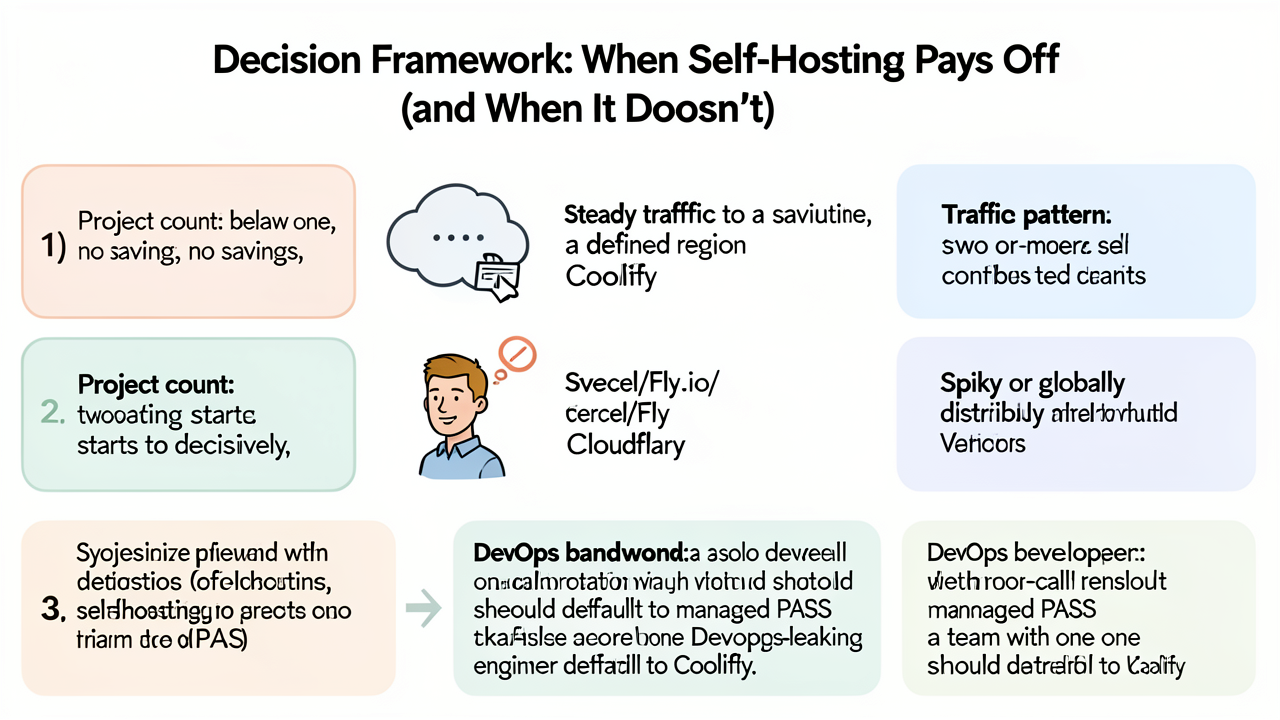
The numbers in the previous sections only matter when mapped to a specific workload. The five checkpoints below are the ones that, in practice, decide whether Coolify or a managed PaaS wins for an indie developer or small team.
A single project almost never justifies Coolify. Once you provision the control plane and add even a modest observability stack, your fixed monthly bill is roughly $150/month — a managed PaaS hobby tier beats that with zero effort. With two or more projects sharing the same Coolify server and dashboard, the control-plane cost amortizes and self-hosting starts to win decisively, because each additional app adds only its container's resource footprint (Temps).
Coolify is anchored to one or a few VPS locations you choose. Steady traffic concentrated in a defined region — for example, a SaaS serving one country — maps cleanly to a single Hetzner or DigitalOcean region. Spiky, global traffic does not: edge platforms like Vercel, Cloudflare, and Fly.io have POPs on every continent and absorb traffic spikes without intervention. If your users span North America, Europe, and Asia, replicating that with Coolify means running and patching multiple servers yourself.
A solo developer with no on-call rotation should default to a managed PaaS. The marginal value of your time is much higher than the saving on a $20 VPS bill. A small team with at least one DevOps-leaning engineer — even part-time — should default to Coolify, because the work shifts from "paying the platform tax" to "maintaining a known stack" that the team already owns (dev.to).
Two different stories here:
Coolify stores all configurations on your own server. If you stop using Coolify, your Docker containers, database volumes, and configs keep running — you lose the automation layer, not the workloads. Leaving Heroku, Render, or Vercel is typically a multi-week migration because of proprietary build pipelines and edge runtimes.
| Workload profile | Default choice |
|---|---|
| 1 project, solo dev, hobby traffic | Vercel / Render hobby tier |
| 2+ projects, 1 DevOps-leaning engineer, single region | Coolify on Hetzner |
| Global traffic, marketing site + API | Vercel or Fly.io |
| EU-only data, GDPR/NIS2 priority | Coolify on Hetzner (Falkenstein/Nuremberg/Helsinki) |
| SOC 2 / HIPAA required, no in-house compliance lead | Render, Fly.io, or DigitalOcean App Platform |
| High lock-in sensitivity, Docker-first stack | Coolify |